India's 2.75 Million-Ton LPG Pivot: Why Energy Security Is Becoming a US Trade Asset
India's 2.75 million-ton US LPG tender is more than a fuel purchase: it is an attempt to turn supply diversification into bargaining power with Washington and Gulf suppliers.
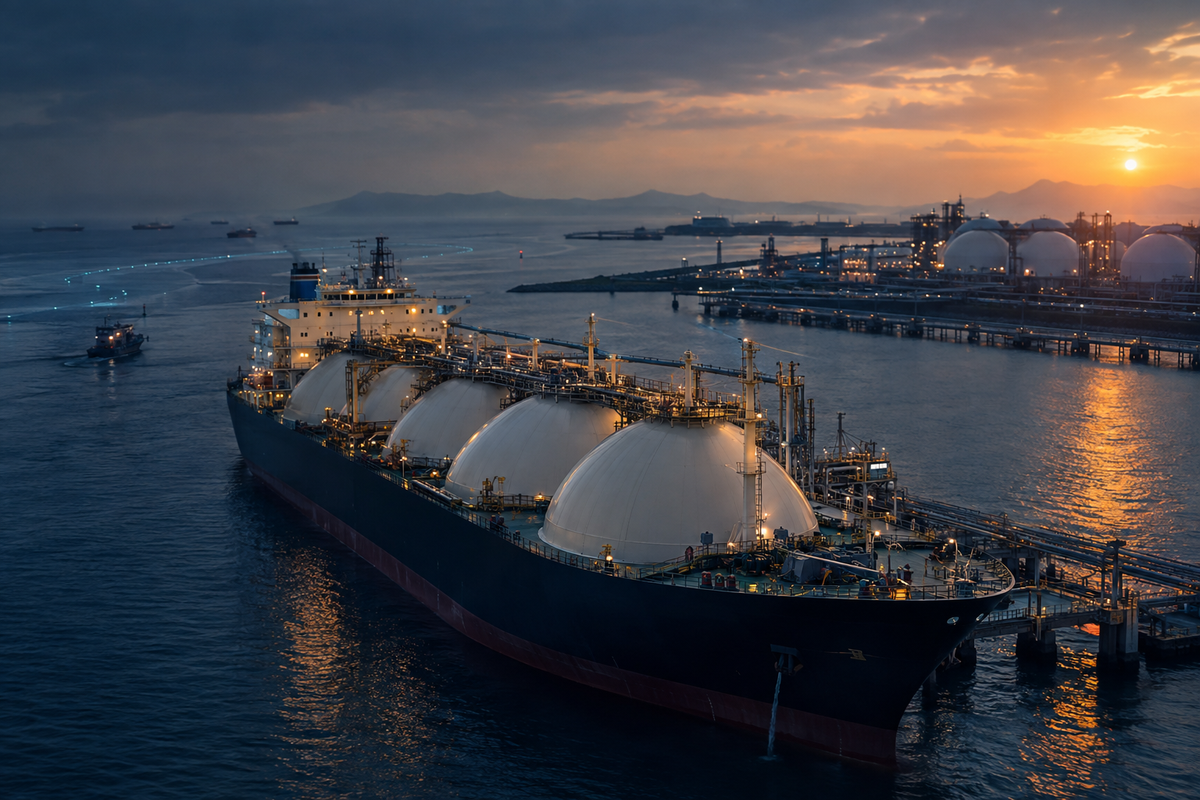
India's state-owned refiners have put a number on the energy map they want to build after the Persian Gulf supply shock: around 2.75 million metric tons of US liquefied petroleum gas for delivery in 2027. Indian Oil, Bharat Petroleum and Hindustan Petroleum are seeking four very large gas carrier cargoes a month, with each cargo split evenly between propane and butane, according to a Sept. 25 Reuters report. The headline is about cooking fuel. The more consequential reading is that India is turning energy security into a trade asset, using a long-haul supply relationship to reduce chokepoint risk, deepen US commercial ties and force a repricing of what a reliable barrel is worth.
That does not mean New Delhi is abandoning the Middle East, or that US cargoes will automatically be the cheapest option. The US route is longer, freight is more exposed to shipping conditions and the delivered price still has to compete with Gulf supply when those flows normalize. The contrarian point is narrower: a crisis-forced procurement switch can become durable even after the crisis fades, because contracts, logistics and trade diplomacy create their own momentum. India's LPG tender is therefore less a simple substitution trade than an attempt to buy optionality before the next disruption.
The tender seeks around 2.75 million tons for 2027 and remains valid until Oct. 22. It calls for four 46,000-ton cargoes per month on a delivered basis, plus one 45,000-ton cargo per month on a free-on-board basis, Reuters reported. Bloomberg separately reported on Sept. 25 that the three refiners were preparing to lift annual US purchases by more than 25%, from 2.2 million tons under 2026 contracts to as much as five 46,000-ton cargoes a month next year. The difference between the Reuters tender and the Bloomberg account is a reminder that the final award may change, but not the direction of travel.
India is the world's second-largest LPG importer after China, and the fuel is not a discretionary industrial input. It is a household necessity, sold through a state-dominated distribution system and politically sensitive subsidy structure. Before the disruption, more than 90% of India's LPG imports came from the Gulf through or around the Strait of Hormuz, according to reporting by Reuters and Indian energy publications. When that route became unreliable, the economics of a 30- to 40-day voyage from the US became secondary to the economics of keeping cylinders filled.
The supply shock changed the definition of cheap
Hardeep Singh Puri, India's oil minister, described the policy response in a Sept. 24 panel discussion reported by The Hindu BusinessLine. “The crisis is certainly not over. In fact, the crisis is not only ongoing, but it has the potential of actually exacerbating. In other words, the crisis could get more serious,” Puri said. His warning matters because it frames the US purchases as insurance rather than a one-quarter arbitrage. At the same event, he said India had increased LPG production from 34,000 tonnes per day to around 54,000 tonnes per day to cover the shortfall caused by the Strait of Hormuz disruption.
The domestic response has already altered the import requirement. India's LPG consumption fell 16% to 11.3 million tons during April-August 2026 from 13.4 million tons a year earlier, according to data from the Petroleum Planning and Analysis Cell cited by Moneycontrol and ThePrint. August consumption alone fell 16% to 2.4 million tons from 2.9 million tons. That looks bearish for import volumes, but it also shows why supply security has a value beyond the spot market: demand was suppressed because availability was uncertain, not because India's long-term household need for cooking gas disappeared.
Pankaj Srivastava, senior vice president for commodity markets and oil at Rystad Energy, told The Times of India on Sept. 8 that India's LPG demand averaged 862,000 barrels per day from March through August, almost 20% below the pre-war average. He added that post-crisis imports averaged around 440,000 barrels per day, or about half of demand, compared with a pre-war average of 785,000 barrels per day. Those figures point to a temporary demand shock, but they also reveal a permanent vulnerability: domestic production can cushion the system, yet it cannot replace the import basket at normal consumption levels.
The US has already moved from marginal supplier to swing supplier. Bloomberg reported that US shipments, including spot cargoes, reached a record 3.9 million tons through August. A Sept. 1 Hindustan Times report, citing government data, said India's imports of US petroleum products, mainly LPG, rose 254% year over year to $2.60 billion in the first quarter of fiscal 2027, while US crude imports fell 57.5% to $1.57 billion. That mix is important. India is not simply buying more American energy; it is changing the composition of the relationship toward the product most urgently exposed to Gulf logistics.
Anmol Bhushan, associate director for LPG at S&P Global Energy CERA, captured the shift in a March 19 S&P Global Energy factbox: “India is increasingly turning to the US for LPG as geopolitical tensions reshape global trade flows. If the Middle Eastern conflict continues for a long period, there is a chance for North American LPG to gain a stronger foothold in the Indian import mix. Recent trade patterns show rising US volumes moving into India.” The quote predates the latest tender, but the data now show the conditional thesis becoming a procurement program.
Trade diplomacy is part of the delivered price
There is a second layer to the tender that the commodity market can miss. India has pledged to increase US energy purchases from $10 billion to $25 billion, while New Delhi and Washington have targeted $500 billion in bilateral trade by 2030, according to Reuters. Buying US LPG helps narrow the trade imbalance that has become a political issue in Washington, while giving India a commercially defensible reason to source a strategic fuel from the US. The trade deal is not the only reason to buy the cargoes, but it changes the acceptable premium for doing so.
That premium is real. Gulf cargoes have a geographic advantage, while US cargoes must cross the Atlantic, pass through the Panama Canal or travel around the Cape depending on destination and market conditions, and tie up vessels for longer. A February Business Standard report quoting Pankaj Srivastava put the US voyage at roughly 32 to 40 days, versus 25 to 30 days for earlier supply routes. The extra time raises working-capital needs and makes freight a bigger part of the delivered price. It also means that a US term contract is not a promise of cheap LPG; it is a promise that some LPG will be available when the short-haul alternative is not.
The cargo specification reinforces that point. The tender requires an even split between propane and butane, rather than allowing refiners to buy whichever component is cheapest at the loading port. That is operationally useful for household supply but less flexible for a trader. It also makes the relationship more strategic: the buyer is paying for a defined product slate, predictable monthly arrival and a hedge against a regional concentration risk. In that sense, the contract looks more like infrastructure than a series of spot purchases.
For US exporters, the opportunity is larger than the Indian tender itself. The US is already the world's leading LPG exporter, and additional long-haul demand can support terminal utilization, shipping demand and the pricing power of Gulf Coast suppliers. But the economics are not one-way. If Asian buyers begin to lock in US volumes as insurance, the marginal US cargo may command a higher premium during periods when domestic US demand, petrochemical feedstock demand or European winter demand also rises. India's diversification can reduce physical risk while increasing the cost of optionality.
For Gulf producers, the risk is not an immediate loss of the Indian market. Existing infrastructure, short sailing times and established grades remain powerful advantages. The risk is that a buyer who once had no credible alternative now has a benchmark. Once Indian refiners have US contracts, a functioning logistics chain and a record of delivered cargoes, Gulf suppliers will have to compete not only on price but on reliability and contract terms. US LPG can therefore act as a price ceiling on traditional suppliers even if it never becomes the cheapest molecule in every month.
There is also a financial-market signal in the tender. India is effectively paying for a portfolio of supply exposures: Gulf cargoes for proximity, US cargoes for scale and political alignment, domestic production for emergency resilience and potentially African or Latin American cargoes for additional optionality. The value is not visible in the average import price. It appears in the lower probability of a single route failure becoming a household shortage, a subsidy shock or a forced spot-market purchase at the worst possible time.
Investors should watch four tests. First, will the Oct. 22 tender produce binding awards, and at what delivered premium to Mont Belvieu-linked US prices? Second, can US cargoes arrive consistently through the shipping route without creating a new dependence on freight capacity? Third, does Indian LPG demand recover toward the 31 million tons projected for 2027 as supply normalizes, or does the crisis accelerate a lasting shift toward piped natural gas and other fuels? Fourth, will Gulf suppliers respond with lower prices, longer credit or more flexible cargo specifications?
Our view is that India's LPG pivot is investable as a resilience and trade-flow theme, not as a call that US cargoes will permanently displace Gulf supply. The near-term winners are the exporters and shipowners able to deliver a standardized product reliably across a long route. The more durable winner may be India itself: not because it has found a cheaper source, but because it has converted a shortage into bargaining power. The next disruption will still move prices. It may no longer determine who can keep India's kitchens supplied.
This note is for informational purposes only and does not constitute investment advice. Sources: Reuters, Sept. 25, 2026; Bloomberg, Sept. 25, 2026; The Hindu BusinessLine, Sept. 24, 2026; S&P Global Energy, Mar. 19, 2026; The Times of India, Sept. 8, 2026; Hindustan Times, Sept. 1, 2026; Reuters, July 28, 2026.