The Iran War and Markets: Finding the Off-Ramp
Brent hit $141. S&P 500 had its worst quarter since 2022. The Fed is paralysed. Markets are now rallying on Trump's claim the war is almost over. Here is the risk framework — and what investors should do before they act on the optimism.
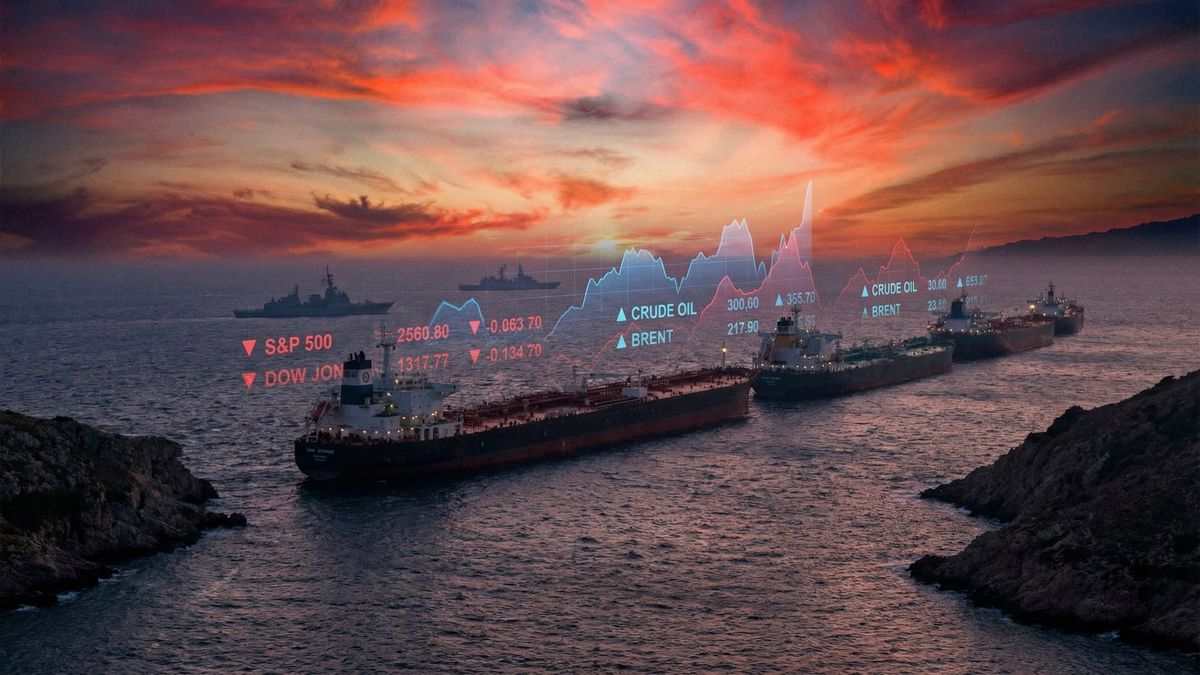
Geopolitical Risk · April 2026
The Iran war has closed the Strait of Hormuz for over a month, pushed Brent crude to $141, shaved 5% off the S&P 500, and trapped the Federal Reserve between inflation and growth. Trump says it is "getting very close" to conclusion. Markets are rallying on that hope. This is the risk framework investors need before they act on it.
The Conflict in Numbers
The US-Iran conflict that erupted in late February 2026 has produced an economic shock whose transmission channels are now well-understood but whose duration remains the central investment question. A month of Hormuz disruption has:
- Pushed Brent crude from approximately $71 (pre-conflict) to $141 on April 2 — the highest since the 2008 financial crisis
- Driven US regular gasoline above $4 per gallon for the first time since 2022
- Produced the S&P 500's worst quarter since Q1 2022 (down 4.6%), with the Nasdaq down 7.1%
- Elevated PCE inflation toward 3.5% year-on-year — the highest since May 2023
- Raised US recession probability estimates from Moody's to approximately 49% — effectively a coin flip
The conflict's financial market impact has been textbook supply-shock economics: an inflationary impulse that simultaneously depresses growth expectations and constrains the monetary policy response. This is the configuration that bond markets fear most — one in which neither the Fed's traditional tools nor fiscal policy can provide a clean solution.
The Current State: Rally on Hope, Not Resolution
As of the week of April 6, markets are in a cautiously optimistic phase. The S&P 500 recorded its best single day since May on Tuesday April 1, rallying 2.9%, and extended gains Wednesday as investors processed Trump's statement that the war is "getting very close" to conclusion. The broader index finished the holiday-shortened week up 3.4%.
That rally is real — but it is pricing in a resolution that has not yet materialised. Trump simultaneously stated the US would strike Tehran "extremely hard" before leaving, suggesting the final phase of the conflict could be both brief and kinetically intense. The Hormuz passage remains substantially disrupted. Brent futures are still above $100. The Fed has not moved.
Veteran market strategist Mark Kolanovic — formerly of JPMorgan — publicly warned investors to "resist this rally," arguing that statements from Washington are designed to keep markets supported and cap oil prices rather than reflect ground truth about the conflict's timeline. Whether his assessment is correct is unknowable, but the risk asymmetry he identifies is real: if the rally is pricing a two-week resolution and the conflict extends two months, the downside is material.
The Federal Reserve: Still Paralysed
The FOMC meeting minutes from March, released this week, reiterated the committee's inability to ease policy in the face of a supply-driven inflation surge. The structural constraint is unchanged: cutting rates into 3.5% PCE inflation would undermine the Fed's credibility in a way that the institution's leadership is not prepared to accept. The March payrolls decline of 92,000 and unemployment at 4.4% are deteriorating, but not catastrophically — not yet at the threshold that would force a shift in the inflation-growth trade-off.
The critical data point this week is Friday's March CPI reading — the first to incorporate any Hormuz-driven energy passthrough. FactSet consensus projects 3.1–3.4% year-on-year. A print above the top end of that range would extend the Fed's paralysis and potentially trigger another leg down in rate-sensitive equities. A print at the low end would provide some cover for the market's optimistic scenario.
The implied path for Fed action has been pushed out materially. Morgan Stanley has moved its first cut call from June to September. Several FOMC members have floated December as the earliest credible window. The longer the conflict persists, the further that window moves.
Energy Markets: The Duration Question
Goldman Sachs had modelled a six-week Hormuz disruption in their base case, projecting Brent averaging $105 in March and $115 in April. The actual spot market — $141 on April 2 — exceeded those projections significantly, suggesting either greater-than-modelled supply disruption, a demand component that wasn't anticipated, or speculative positioning amplifying the fundamental move.
ANZ's commodity analysts note that the conflict has driven up not just crude oil but fertilisers, industrial gases including helium, and a range of commodities that transit the Gulf. These secondary effects take longer to appear in inflation data but are already visible in producer price surveys and shipping cost indices.
For the energy trade specifically, three scenarios frame the distribution:
Resolution within 2–3 weeks (Trump's stated timeline, 35% probability): Hormuz reopens, Brent retraces toward $90–95, PCE moderates, Fed cuts in September, S&P 500 recovers toward 5,800. This is what the current equity rally is pricing.
Extended conflict, 6–8 more weeks (50% probability): Brent settles in $100–$120 range, CPI prints above expectations through May, recession probability crosses 50%, Fed paralysed through Q3, S&P 500 trades in 4,800–5,400 range with elevated volatility.
Escalation — ground operation or Iranian retaliation against Gulf infrastructure (15% probability): Brent above $150, US recession in H2 2026, Fed forced to cut despite inflation, dollar weakens sharply, gold above $3,500, S&P 500 tests 4,000–4,500.
Asia Pacific: Exposure Map
For institutional investors with Asia Pacific portfolios, the Iran conflict creates differentiated impacts that require active rather than passive positioning.
Japan is a structural energy importer with approximately 90% of crude oil sourced from the Middle East. Higher oil is unambiguously negative for Japan's current account and corporate margins in energy-intensive sectors. The yen's safe-haven status provides partial offset — JPY appreciation compresses export margins but also attracts capital flows. The Bank of Japan's April rate hike probability, elevated by the Tankan survey, creates an additional complexity: a BOJ hike into an oil shock would be unusual monetary policy behaviour with unpredictable transmission.
South Korea's export data has shown remarkable resilience, continuing to surge despite war risks. This reflects the structural nature of semiconductor demand — Korean memory chips going to AI data centres in the US and Europe do not stop shipping because of a Middle East conflict. The exposure for Korea is indirect: higher energy costs compressing domestic margins, and slower global growth eventually dampening semiconductor upgrade cycles.
India is a significant oil importer and is acutely exposed to energy price inflation. However, India's fiscal position allows more room for demand-side stimulus than most APAC economies, and the domestic consumption story is less directly tied to global trade flows than Korea or Taiwan. Indian equities' domestic liquidity base provides some insulation from the capital outflow dynamic that hits more externally-oriented APAC markets during global risk-off events.
Portfolio Positioning: The Off-Ramp Trade
Reuters' April 1 morning briefing was titled "Finding the 'off ramp'" — a phrase that captures the central portfolio management question right now. How do investors position for a conflict resolution they cannot time, without being overexposed to a prolonged scenario they cannot rule out?
The institutional framework we use has three components:
Keep energy exposure: Long oil producers and energy infrastructure remains valid until there is a verified, not merely announced, Hormuz reopening. Brent at $100+ with a functional ceasefire narrative is a 20–30% correction from the April 2 peak — energy stocks have not fully priced the downside of resolution, nor have they fully priced the upside of escalation. The asymmetry favours maintaining rather than exiting.
Reduce duration risk: The bond market is not providing the traditional equity hedge in a supply-shock inflationary environment. The 10-year Treasury yield has been sticky above 4% despite growth fears — a sign that inflation premium is dominating the safe-haven bid. Short-duration instruments at 3.5–4.25% yields provide positive real returns without duration risk.
Buy quality on rallies, not chasing: The April 1–2 equity rally deserves scepticism. Not because equities are wrong to rally on ceasefire hopes, but because the prices at which they have rallied leave limited margin of safety if those hopes are disappointed. Adding quality equity exposure on dips — stocks with domestic revenue, pricing power, and strong balance sheets — is more attractive than chasing the rally at these levels.
The Week Ahead: Key Watchpoints
The calendar this week carries more than usual macro significance. Friday's March CPI (consensus 3.1–3.4% YoY) is the single most important data release for Fed expectations. Wednesday's FOMC minutes (from the March meeting) are already released and confirmed the paralysis narrative. Delta Air Lines reports Wednesday — the first major indicator of consumer spending resilience at elevated fuel costs. And any escalation or de-escalation news from the Iran front could override the data calendar entirely.
Mark Newton at Fundstrat has said he would prefer to wait for consolidation between April 5–9 before adding equity exposure rather than chasing the short-term rebound. Even Warren Buffett stated on April 1 that stocks had not yet reached a low enough price point for Berkshire to invest. These are not panic signals — they are discipline signals from experienced capital allocators who have seen this pattern before.
Investment Conclusions
The Iran war has delivered the macro shock that the 2026 risk calendar identified as a tail risk and that is now a central scenario. The conflict's duration is the single variable that separates a painful-but-manageable correction from a genuine recession. Markets are currently pricing an optimistic timeline. The probability distribution suggests that optimism may be premature.
The investment posture for the weeks ahead: maintain energy exposure, avoid long duration, add quality equity selectively on weakness rather than chasing rallies, and preserve optionality. The off-ramp will come. The question is the price at which you want to be positioned when it does.
John Grey, Founding Editor. Solomon Grey Capital, April 2026. Not investment advice. Data sourced from Reuters, CNBC, Goldman Sachs Research, JPMorgan, and publicly available market data.