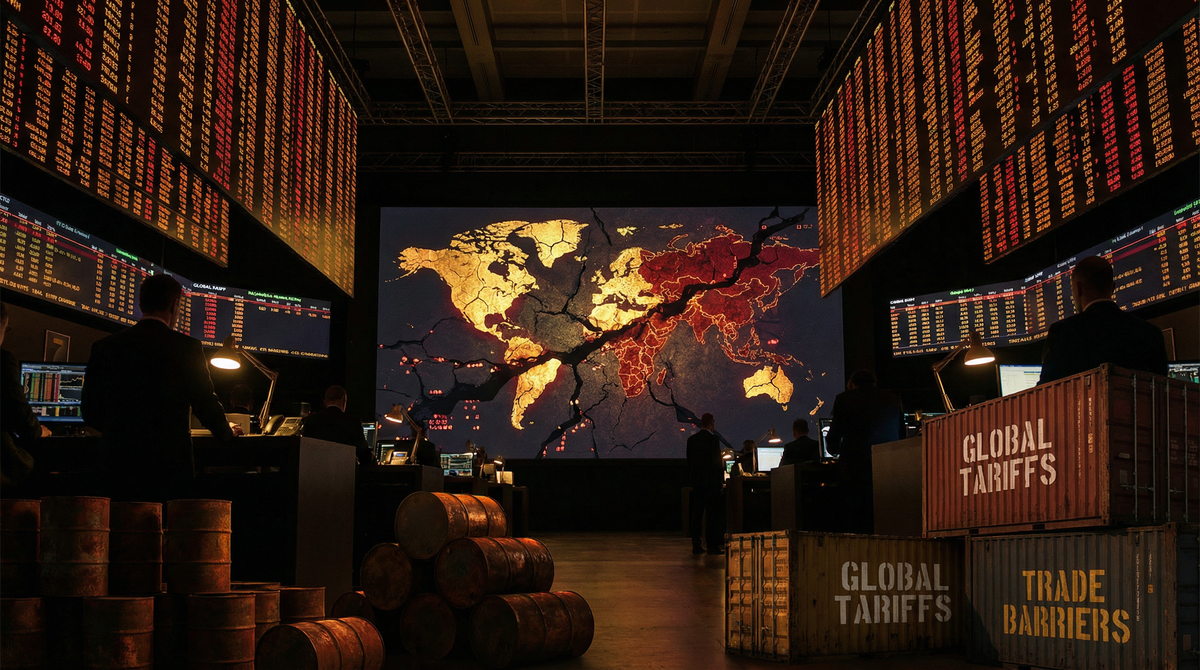
Market Dispatch · 3 April 2026
A two-day equity rout, a Supreme Court ruling that rewired US trade policy, an oil spike to $141, and a Trump-Xi summit that left more questions than answers. Here is what happened — and what it means for portfolios.
The Week in Four Numbers
- –4.6% — S&P 500 return for Q1 2026, its worst quarter since Q1 2022
- –7.1% — Nasdaq decline in Q1 2026
- $141 — Spot Brent crude on April 2, the highest since the 2008 financial crisis
- 49% — Moody's Analytics AI recession model probability, assessed before this week's oil surge
How We Got Here: The Trade War Timeline
The current macro stress did not arrive overnight. It is the cumulative result of 12 months of escalation since "Liberation Day" — April 2, 2025 — when the Trump administration imposed a 10% universal baseline tariff on all US imports, with higher "reciprocal" rates on 57 countries. CSIS described it at the time as "the most sweeping tariff hike since the Smoot-Hawley Tariff Act" of 1930.
What followed was a rapid-fire escalation. Within a week, US tariffs on Chinese goods reached 125%, China retaliated at 84% then 125%, and the S&P 500 lost more than 10% in two trading days. The White House blinked: on April 9, 2025, Trump announced a 90-day pause on reciprocal tariffs for all countries except China. Stocks surged 9.5% in a single session — the best day since 2008.
By October 2025, a partial truce. At the APEC summit in Busan, Trump and Xi reached a framework agreement: fentanyl tariffs reduced, Liberation Day reciprocal rates suspended at 10% for one year, Chinese rare earth export controls paused, agricultural purchase commitments made. The effective US tariff rate on Chinese goods fell to approximately 20–25% — still elevated, but a de-escalation from the 125% peak.
Then, in February 2026, the Supreme Court struck down Trump's IEEPA-based tariffs — the legal foundation for his broadest measures. Trump immediately announced a new 10% global tariff under a different statute, with a threatened escalation to 15%. Two new Section 301 trade investigations into China were launched in March 2026. And Trump flew to Beijing March 31–April 2 for his first presidential visit to China since 2017.
This Week: The Beijing Summit and What It Did Not Resolve
The Trump-Xi summit that concluded on April 2 was the most anticipated diplomatic event of 2026. Markets had priced in a constructive outcome — the S&P 500 rallied 2.9% on April 1 in anticipation. The reality was more ambiguous.
The summit produced no formal trade deal. What emerged was a continuation of the existing truce architecture: extensions of current tariff suspension timelines, commitments to ongoing Section 301 consultation processes, and pledges from Beijing on agricultural purchases and fentanyl cooperation. China launched two new investigations into US trade practices simultaneously — widely read as a defensive negotiating position ahead of May talks.
The gap between market expectations and outcome was the story of the week. The S&P 500's year-to-date performance captures it precisely: down 4.6% through Q1, with the index having rallied hard into the summit on hopes of resolution, only to find that the structural trade tensions remain unresolved.
Oil: The Bigger Shock
Separate from, and currently more consequential than, the trade war is the energy shock. Brent crude futures settled around $104–$109 in late March 2026. Spot Brent hit $141 on April 2 — the highest since the 2008 financial crisis — as Strait of Hormuz disruptions from the Iran conflict tightened physical supply to an extreme degree.
This is not a demand-driven price increase. It is a supply shock, which makes it far more damaging to the growth outlook. A demand-driven oil rally would signal a strong economy. A supply shock of this magnitude acts as a tax on every sector that consumes energy — which is every sector — while simultaneously pushing inflation higher and constraining the Fed's ability to respond.
Goldman Sachs had forecast Brent averaging $105 in March and $115 in April, assuming approximately six weeks of Hormuz disruption. The spot market blew through those estimates. Trading Economics' current model projects Brent at $119.58 by end of Q2. If correct, PCE inflation will reach 3.5% year-on-year by April — the highest since May 2023 — with further upside risk.
The Fed: Caught in the Policy Trap
At its March 18 meeting, the FOMC held rates steady at 3.50%–3.75% for the second consecutive meeting, voting 11–1. The dot plot showed the median member projecting one 25bp cut in 2026 — unchanged from December, but the internal distribution shifted meaningfully more hawkish: 14 of 19 members now forecast either no cut or a single minor adjustment.
The central bank's dilemma is structural. It cannot ease into a supply-side inflation shock without sacrificing credibility. It cannot tighten further with the labour market already deteriorating — February payrolls fell 92,000, unemployment rose to 4.4%, and GDP was revised down. The FOMC statement acknowledged the Iran conflict explicitly, noting its "implications for the U.S. economy are uncertain."
That phrase — "uncertain" — is doing an enormous amount of work. Translated: the Fed has no reliable model for this environment, and will not move until the energy shock resolves or the labour market deteriorates to a degree that overrides inflation concerns.
"The risks of a recession are quite elevated — and unless the hostilities cease soon, and the president finds a way to de-escalate, declare victory, and move forward... I think a recession is very likely by the latter half of the year."
— Mark Zandi, Chief Economist, Moody's Analytics
Recession Scoreboard: Where Wall Street Stands
| Institution | 12-Month Recession Odds | Prior Estimate |
|---|---|---|
| Moody's Analytics (Zandi) | ~49% | 35% |
| EY-Parthenon (Daco) | 40% | 25% |
| JPMorgan | 35% | 20% |
| Goldman Sachs | 30% | 25% |
| Historical baseline | ~15–20% | — |
One important nuance: Moody's 49% figure was calculated before this week's oil surge. Zandi has stated the probability would cross 50% if oil remains elevated "for weeks rather than months." At current spot prices, that threshold is close to being breached.
What Actually Moved Markets This Week
Equities
The S&P 500 ended Q1 2026 down 4.6% — its worst quarter since Q1 2022. The Nasdaq shed 7.1%. The Dow fell over 3,600 points from its 50,000 peak. Wednesday April 1 saw a 2.9% single-session bounce on summit optimism (S&P closed at 6,575), but the year-to-date damage is real: the index is down approximately 6.7% from its January peak and within striking distance of the standard 10% correction threshold.
Sector breakdown: Energy was the week's sole winner, driven by oil prices. Materials, Industrials, and Consumer Discretionary bore the heaviest selling pressure. Financials, sensitive to recession repricing, underperformed. Technology — particularly hardware with Asian supply chain exposure — remains under pressure from ongoing trade investigation uncertainty.
Fixed Income
The bond market is not pricing a traditional recession hedge. Under stagflationary conditions, bonds and equities sell off simultaneously — the correlation breakdown that invalidates traditional 60/40 portfolio logic. The 10-year Treasury yield has been sticky above 4%, reflecting inflation premium rather than declining with growth fears as it would in a demand-led downturn. Short-duration instruments (T-bills at 3.5%–4.25%) offer positive real yields without the duration risk.
Commodities and Currency
Gold held above $3,000 through the quarter — its status as a stagflation hedge confirmed. Bitcoin tracked risk assets lower in March before recovering. The yuan sits at approximately 6.88 per dollar — stronger than where it began 2026 (7.03 in January), supported by PMI expansion data and stimulus expectations. This is counterintuitive given trade war rhetoric but reflects China's policy managers deliberately containing depreciation to avoid triggering capital outflows.
Three Watchpoints for the Coming Weeks
1. April 6 negotiation deadline. Iran war ceasefire talks have a market-implied deadline around April 6. If the Hormuz disruption persists beyond this point without a visible resolution path, Brent at $120+ becomes the base case and Zandi's 50% recession threshold is likely crossed. A credible ceasefire signal would be the single most positive macro catalyst available.
2. US Section 301 investigation hearings. Scheduled for April and May, these hearings will determine whether the administration pursues new tariff mechanisms to replace those struck down by the Supreme Court. The outcome will determine whether US-China trade relations stabilise at the current truce level or re-escalate through a new legal pathway.
3. April CPI (April 10). If March CPI prints above consensus — highly likely given energy passthrough — it reinforces the Fed's paralysis and pushes any rate cut expectations to December at the earliest. A hotter-than-expected print would also accelerate the repricing of equity multiples, which are still pricing in eventual Fed easing.
The Investment Posture
This is not the time for strong directional conviction. The range of outcomes — from ceasefire and trade deal resolution to oil at $150 and a technical US recession — is wide enough that portfolio construction should prioritise resilience over return maximisation.
The asymmetry favours energy exposure (long oil producers, infrastructure), short-duration fixed income over intermediate bonds, and selective quality equities with domestic revenue and pricing power over global cyclicals. Gold remains a structural hold. The most dangerous position right now is concentrated exposure to long-duration assets priced on a "soft landing eventually arrives" thesis — because that thesis is being tested harder than at any point since 2022.
Solomon Grey Capital Research Team, 3 April 2026. This analysis is for informational purposes only and does not constitute investment advice. All data sourced from publicly available reporting as of publication date.