Meeting the Spirit of Sport on the Pickleball Court
A Hong Kong school principal on how a signed pickleball paddle, a tape-marked playground court, and an inclusive game became a quiet lesson in perseverance.
Originally published in Wen Wei Po (文匯報), 23 April 2026, in the column 文苑英華 ("Flowers of the Literary Garden"). Translated and reproduced here in English with light adaptation; the views are the author's own.
Meeting the Spirit of Sport on the Pickleball Court
It was at the end of last year that I first came into contact with "pickleball" — and with a pickleball paddle.
At the premiere of a film, I was given a paddle personally signed by one of the film's leading actors, Mr. Louis Cheung. I passed this gift on to my school, and in doing so planted the seed of an idea: to introduce this emerging sport onto our campus.
I was later honoured to receive an invitation from the China Hong Kong Pickleball Association to attend the 2025 Pickleball World Championships at the Discovery Bay Recreation Club on Lantau Island. Alongside the tournament itself, the organisers were also raising funds for the residents affected by the Tai Po fire.
Several students and teachers from my school volunteered as helpers at the event. One of those student volunteers, during a break in proceedings, took to a practice court to play a few points against me. She turned out to be a member of the school's tennis team — and the fact that I was able to keep the rally going for several exchanges already felt like an honour to me.
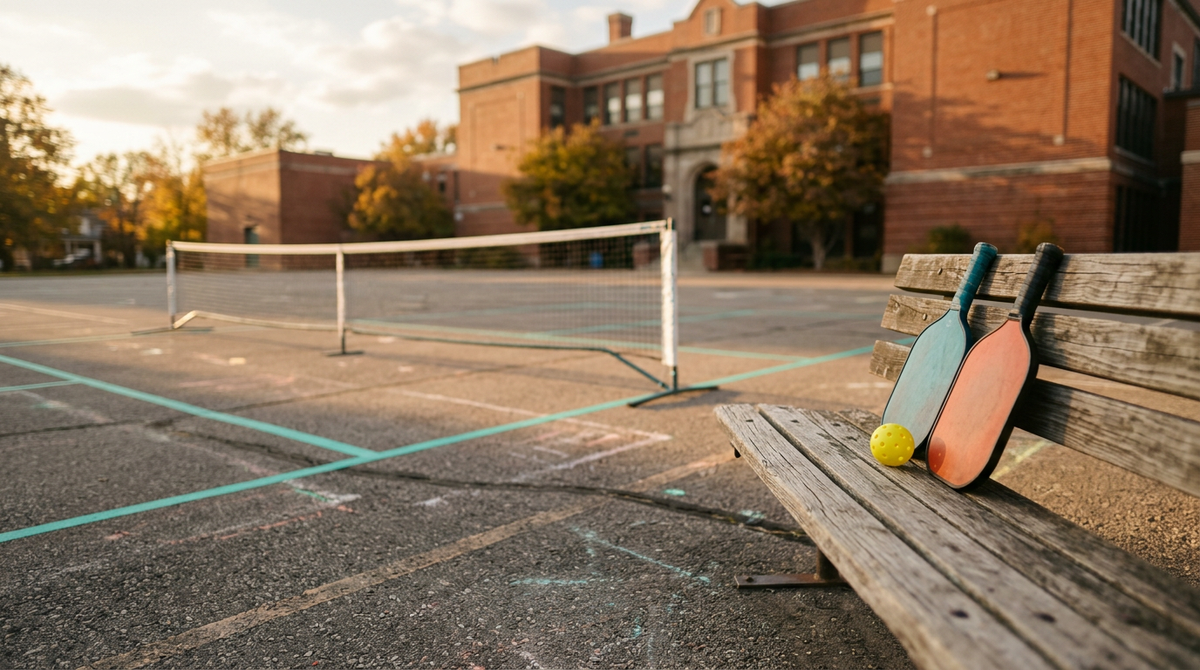
To bring the sport onto our own campus, a professional coach helped us mark out a court with coloured tape on the playground floor, and we wheeled a portable net onto the dividing line between the two halves. Just like that, a regulation pickleball court came to life before our eyes. The school invited four senior students to test the new court, and asked them to autograph the brand-new paddles they had just used — a small opening ceremony of sorts. We then edited footage of their play into a short film, which was screened during a flag-raising assembly to formally introduce pickleball to the entire student body.
Whether judged by the size of the court, the weight of the ball, the dimensions of the paddle, or the intensity of play, pickleball really does feel like a miniature version of tennis. Although I am no longer young, I found that I could hold my own well enough on my first attempt at the game.
Inclusion, One Rally at a Time
The threshold for taking up pickleball is low and the physical exertion moderate, which makes it well suited to people of all ages. With that in mind, an idea struck me: beyond the general public, why not invite people with special needs to take part as well? Why not create a space where they too could "make friends through the sport," widen their social circles, and give the wider community a chance to learn the spirit of "within the four seas, all are brothers" — the spirit of inclusion?
On one occasion, I arranged for paintings by trainees of the Hong Chi Association to be exhibited in our school's gallery, and invited the artists to come and share the stories behind their work. After the sharing session, I also invited them onto the pickleball court. Once they began to play, they showed real form — a serve from one side, a return from the other, the ball travelling back and forth — and they took clear delight in the exchange. It turns out that, with a little thoughtful planning, pickleball can also be a vehicle for inclusion: a way of closing the distance between people.
At our school's PTA Carnival Day, I made sure parents and children had the chance to try pickleball together. I even put on the uniform of an ancient general and joined them on court — drawing comments from onlooking parents that a general from a bygone dynasty had stepped through time to play a few rounds.
The NGO "CityLab" (幸福實驗室) — sponsored and supported by Mr. Lau Wang-chi on behalf of the TGG Family Foundation — has been bringing pickleball into schools as a means of helping students build a growth mindset, and our school has been fortunate enough to be one of the pilot sites. Beyond that, I hope to use pickleball to teach our young people the spirit of true sportsmanship: that "victory and defeat are the constant companions of any soldier"; that "if others can do it once, I will do it a hundred times — if others can do it ten times, I will do it a thousand"; that "when an arrow is loosed and misses, one does not blame those who outshoot one"; and that "it is precisely because one does not contend, that no one in the world can contend with him." It is in lessons like these that I hope our students learn perseverance — so that one day they may stand firmly on their own feet.
"When a thing reaches its limit, it must change; when it changes, it can endure." Pickleball has come into the world in just such a way.
English adaptation of an essay by Principal Lo Wai-shing MH, originally published in Wen Wei Po on 23 April 2026. Reproduced with attribution; the original Chinese article can be found at wenweipo.com. Solomon Grey Capital publishes occasional guest essays alongside its institutional research; the views expressed are those of the author and not necessarily those of Solomon Grey Capital.