Fort Worth's Two-Ton Fact: Why America's AI Reindustrialization Is Already Shipping
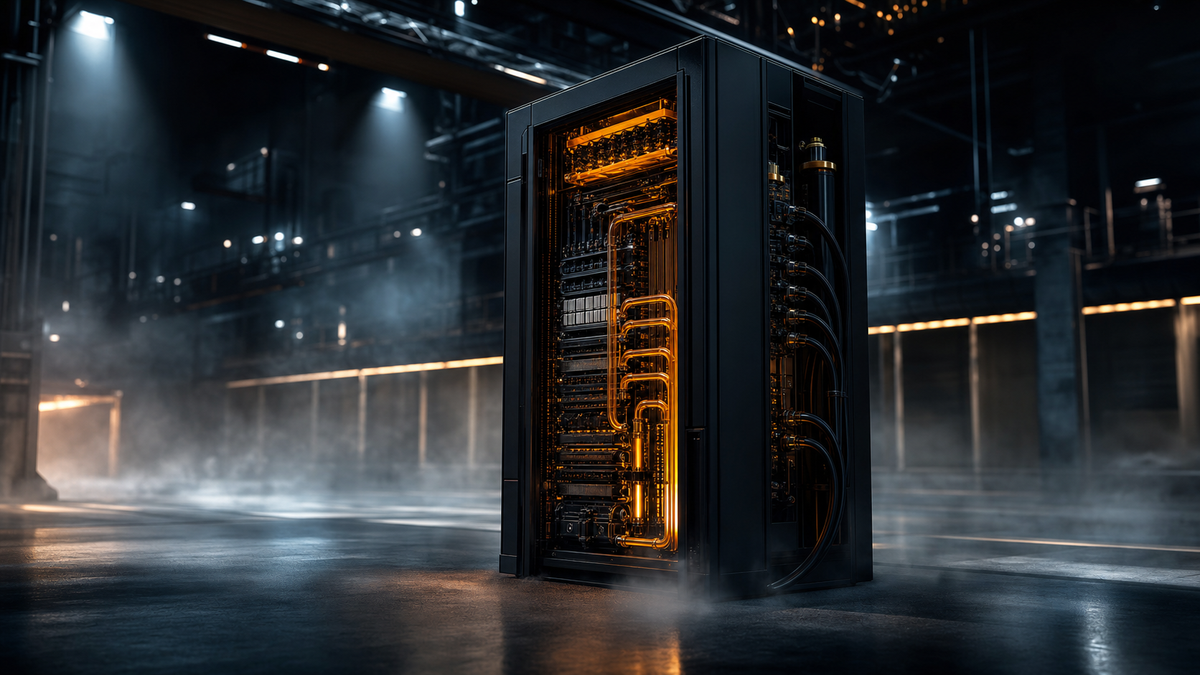
The machine weighs two tons, contains roughly 1.5 million individual parts, and lists at approximately four million dollars. On July 21, Jensen Huang signed the first one built at Wistron Corporation's newly opened D1 smart factory in Fort Worth, Texas — the first Nvidia GB300 Grace Blackwell Ultra Superchip mass-produced on American soil. Twenty-four hours later, the Nvidia founder was in Monterey, California, personally commissioning a second GB300 unit at the Naval Postgraduate School. That one was not sold. It was donated.
Investors have spent the past three years pricing US semiconductor reindustrialization as a forecast — an event that will happen when TSMC's Arizona fabs reach volume production, when the CHIPS Act disbursements convert into physical output, when the multi-year lag between wafer subsidy and finished node finally closes. The consensus timeline still runs to 2027 and 2028. The events of July 21 and 22, taken together, argue that the market is looking at the wrong control point. The scarcity is no longer at the wafer. It has migrated one level up the stack, to the rack-scale integrated system, and that scarcity is already being produced in Texas.
Wistron's D1 facility spans about 324,000 square feet and cost roughly $700 million to build. It employs an initial workforce of around 500, expected to double to 1,000 by year-end. Its output is the current data center flagship of the AI industry: a rack-scale platform that pairs 72 Blackwell Ultra GPUs with 36 Grace CPUs across a single coherent memory domain, delivering 1,440 petaflops of FP4 compute — a system that Huang, standing on the factory floor, described as “the most powerful AI supercomputer in the world.” The word he used to characterize the pace of production was not exotic. He said the company was making them the way it makes phones.
“The largest infrastructure buildout in history is underway. Demand for AI factories — the engine of this next industrial revolution — is incredible, and they must be produced everywhere. Together, NVIDIA and Wistron are restoring US advanced manufacturing capacity in Texas, creating skilled jobs and strengthening America's AI supply chain.”
Those were Huang's remarks at the D1 grand opening, distributed through PRNewswire on July 21 and carried on Morningstar's newswire the same day. Read closely, they are not a promise. They are a status report. The factory is open. The line is running. The first unit is signed.
The donation that matters more than the sale
The following morning, Huang flew to Monterey. At a ribbon-cutting inside the Naval Postgraduate School's Converge @ NPS event, he stood alongside Adm. Samuel J. Paparo, Commander of US Pacific Command, and retired Vice Adm. Ann E. Rondeau, the school's president, to commission the first DGX GB300 supercomputer to be installed in a US military research environment. Randy Pugh, the officer who led the school's AI task force during deployment, told Unite.AI that the system carried an approximate list value of $15 million and was the second unit off Nvidia's production line. It did not arrive through the standard defense procurement process. Nvidia channeled it as a donation through the Naval Postgraduate School Foundation, under a cooperative research and development agreement the two parties signed in December 2024.
That structural detail is worth pausing on. The Department of Defense has spent much of the last decade attempting to compress the acquisition cycle for advanced computing — the interval between when a technology is commercially available and when it is available to war-planners. The traditional pipeline can extend to five or seven years. In this instance, the interval collapsed to weeks. A rack-scale system commercially released in the second quarter of 2026 was in a US military lab, running Nvidia's Mission Control orchestration software, before the end of the third quarter. The mechanism was a gift, structured through a foundation, under a CRADA — and the visible participants were the sitting commander of Pacific Command and the founder of the company that supplies essentially every frontier AI model on earth.
“AI will be a backbone of America's defense. By supporting the Naval Postgraduate School and placing one of the world's most advanced AI supercomputers in the hands of the men and women who defend our Nation, we are empowering them to train on it, build with it, and lead America's fighting force with the decisive advantages our Sailors, Marines and Joint Force deserve.”
That is Huang, quoted in the Naval Postgraduate School's own official release published on Navy.mil on July 22. Paparo's remarks, delivered at the same podium and captured in the same official communication, offered the counterpart doctrine.
“To achieve absolute decision superiority, we must leverage data, compute, and human-machine integration to observe, orient, decide, act, assess, learn and adjust faster than any adversary. As we connect these capabilities across space, sensors and networks, our operational advantage does not merely grow by addition, it compounds to deliver overwhelming joint effects.”
Read together, Huang and Paparo were describing the same object from opposite ends. One saw a two-ton machine leaving a Fort Worth loading dock. The other saw a battlefield decision loop compressing under compounding computational advantage. The through-line is that both men were referring to hardware that already exists and is already in operation.
The scarcity has moved up the stack
The dominant investor framing since 2023 has placed the strategic bottleneck at the wafer. That thesis produced a sequence of trades — long TSMC, long the equipment providers, long the CHIPS Act beneficiaries — that assumed the constraint was upstream and the constraint would loosen slowly. That thesis is not wrong. It is incomplete. What the Fort Worth and Monterey events indicate is that a second, higher-order constraint has emerged at the rack. The Grace Blackwell Ultra system Wistron is now producing is not simply a collection of chips. It is a liquid-cooled, coherently-interconnected, orchestration-integrated compute platform that requires roughly 1.5 million individual parts to be assembled to sub-millimeter tolerance, and that operates only when its 72 GPUs, 36 CPUs, memory fabric, NVLink switch complex, power delivery, and thermal management function as a single machine. Very few facilities on earth can produce such a system at volume. Until July 21, none of them were in the United States.
Simon Lin, Wistron's chairman, described the ambition without embellishment during the Fort Worth ceremony. His remarks were carried in the same PRNewswire distribution.
“The operation here is not typical manufacturing. It is new, very comprehensive, and high-tech. Right now we produce the NVIDIA GB300 Grace Blackwell Ultra Superchip, and beyond, we are also going to produce the NVIDIA Vera Rubin Superchip here.”
Lin also indicated during the same event that Wistron plans to build a D2 facility approximately twice the size of D1, with D3 and D4 sites under evaluation. The Vera Rubin platform — Nvidia's 2026-2027 successor to Blackwell Ultra, projected to deliver on the order of ten times the tokens-per-second of the current generation at the same 150-megawatt envelope — is now on the roadmap for the same Fort Worth footprint. In other words, the D1 facility is not a one-time gesture. It is the first node in a US manufacturing network that Nvidia intends to keep at the current generational frontier.
Huang framed the industrial context in a second Fort Worth remark, delivered from the same podium and quoted by IT Brief and Tech Times: “Manufacturing is an essential pillar for every economy and every country. Building chip plants, packaging plants, computer system plants like this, and AI factories all over the United States, has allowed the United States to really reindustrialize for the first time in a long time.” The verb was past tense. Has allowed. Not will allow.
Our view
The consensus narrative continues to price the US AI supply chain as a work in progress subject to execution risk. That risk-adjusted framing is out of date. The events of July 21 and 22 collapse two assumed lag periods simultaneously. The first is the commercial lag between chip design and rack-scale system availability inside the United States — that lag has closed to zero, because the first US-built GB300 shipped this month. The second is the acquisition lag between commercial release and operational military use — that lag has been compressed from years to weeks, via a donation structure rather than a procurement one, with the sitting Pacific Command chief present at the ribbon-cutting.
What follows from this, we think, is a re-pricing of the system integrator layer rather than a further re-pricing of the wafer layer. The rack, the liquid-cooling loop, the memory-fabric integration, and the orchestration software constitute the current binding constraint on AI factory output. The names on the invoice at that level are narrower than the names at the wafer level. Investors who have concentrated their AI-infrastructure exposure at the foundry should widen the aperture. Whether Wistron itself is the correct instrument for that exposure is a secondary question — the primary question is whether the rack, not the chip, is now the strategic scarcity. On the evidence of the last ten days, it is.
The second implication is subtler and applies to sovereign-risk pricing across the AI stack. A GB300 in Monterey, delivered as a donation to a US military research institution, is a signal that Nvidia has moved beyond commercial neutrality and toward strategic alignment with US national security infrastructure. The market has not yet integrated what that means for the company's addressable market in defense, for its diplomatic exposure in Asia, or for the pricing of similar arrangements that competitors — AMD, Intel, Cerebras — may or may not be positioned to replicate. That integration will happen. The question is whether it happens before the next earnings print or after.
Solomon Grey Capital publishes research and commentary for informational and educational purposes only. Nothing in this note constitutes investment advice or a recommendation to buy or sell any security. Readers should conduct their own analysis and consult a licensed adviser before acting on any information contained herein. Sources referenced include Reuters, Morningstar, PRNewswire, Navy.mil, Unite.AI, Tech Times, IT Brief, and Pulse 2.0; quoted statements are drawn from public, on-the-record remarks at the July 21 Wistron D1 grand opening in Fort Worth and the July 22 DGX GB300 commissioning at the Naval Postgraduate School in Monterey, California.