The 2016 Line: China's Property Free-Fall Has Erased Two Decades of Wealth, and Beijing Has Stopped Pretending Otherwise
China's real, inflation-adjusted home prices have fallen below their 2016 level for the first time in a generation. The rebalancing story is over — Beijing has quietly chosen manufacturing capacity over household consumption, and the property market is paying the bill.
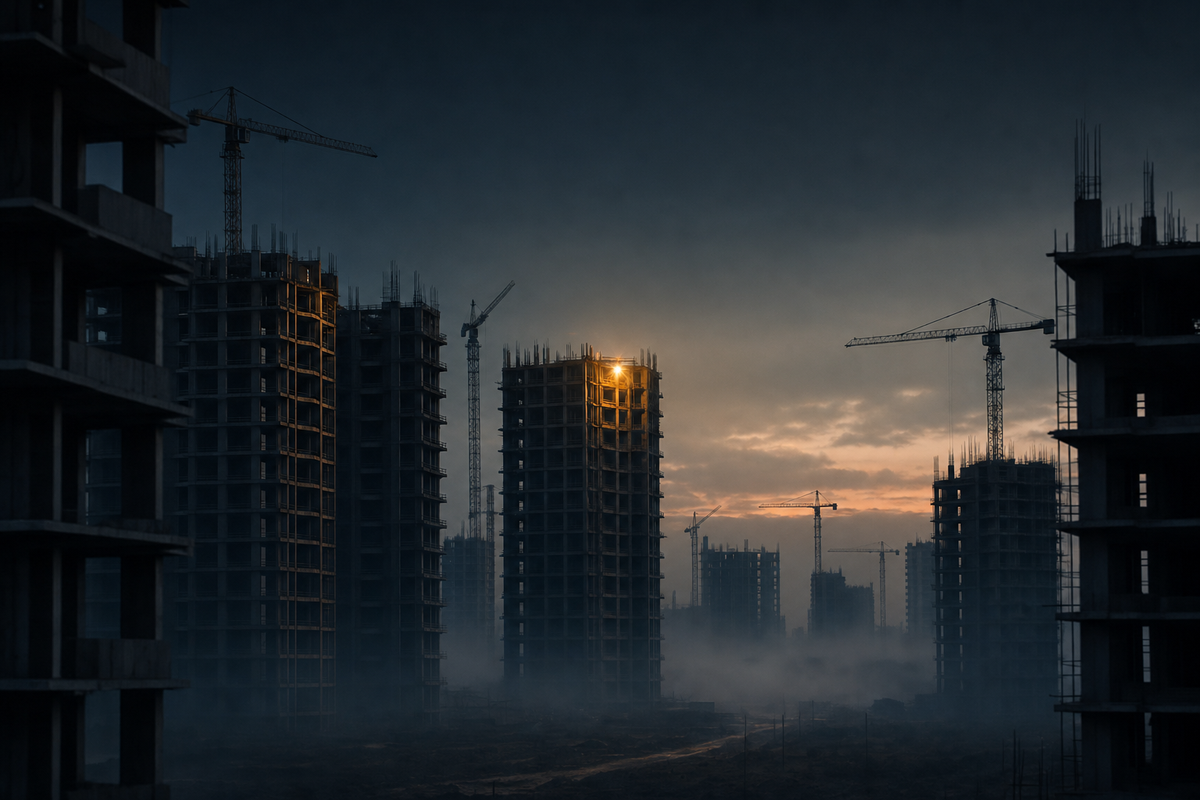
For the first time in nearly a generation, real home prices in China have fallen below where they stood in 2016. The Bank for International Settlements' inflation-adjusted index for Chinese residential property closed the first quarter of 2026 at 85.1, below the 88.5 reading of the second quarter of 2016 and 41 percent beneath the nominal peak of late 2021. In one quiet number sits the erasure of a decade of household wealth accumulation. In June, according to data compiled by China Index Academy and released on July 1, secondary home prices fell in 88 of the 100 largest cities, with the national average dropping to 12,639 yuan per square metre. Nanjing was down 11.45 percent year on year, Wuhan 10.89 percent, Beijing, Tianjin, Guangzhou and Chongqing all between 8 and 10 percent. Of the 70 tier-one and tier-two cities tracked by the National Bureau of Statistics, only four registered any year-on-year increase in new-home prices between January and May. In the secondary market, that number was zero.
The consensus reading in Western strategy notes still frames this as a cyclical trough with policy support on the way. That reading is wrong. What is happening in Chinese property is not a demand recession Beijing is waiting to reflate. It is the visible price of a rebalancing failure the Party has quietly decided to stop reversing. The consumption economy has been traded for manufacturing capacity, and households are absorbing the loss.
The rebalancing that never happened
The clearest articulation of the problem comes from an unexpected quarter. Stephen Roach, the former chief economist and Asia chair at Morgan Stanley, wrote in a late-June essay circulated through Project Syndicate and his own Substack that the numbers no longer allow the polite framing that had characterised a decade of China commentary.
"China's efforts to rebalance its economy have been an abject failure," Roach wrote in a piece titled bluntly "China's Failed Rebalancing." Household consumption, he noted, stood at 39.9 percent of GDP in 2024, effectively unchanged from 39.8 percent in 2005 — the year before the leadership first publicly identified rebalancing as the country's central economic priority.
Twenty years, in other words, of stated policy intent, five-year plans and Party communiques, and the consumption share of the Chinese economy has moved less than one-tenth of one percentage point. What has moved instead is capacity. Roach's projection that China's share of global manufacturing output could rise from roughly 32 percent today to 45 percent by 2030 is not an aspirational forecast. It is a statement about where the credit is going, and it is why European and American trade responses have hardened into open protectionism.
The property market is the accounting entry that squares that ledger. For twenty years Chinese households treated residential real estate as a substitute for the pension system, the equity market, and the credit deposit rate. Roughly 70 percent of urban household wealth is estimated to sit in property. When that anchor moves, the marginal propensity to consume moves with it — which is exactly what May's retail sales data showed. Chinese retail sales fell 0.6 percent year on year in May, the first outright monthly decline in three and a half years.
A two-speed economy, priced in one currency
The June activity data released at the end of the month captured the split cleanly. The official manufacturing PMI printed 50.3, with the high-technology sub-index at 53.5 and the consumer-goods sub-index at 50.2. External demand and technology exports are running; the domestic household economy is not.
Julian Evans-Pritchard, head of China economics at Capital Economics, told CNBC on June 30 that external demand and AI-related technology exports were the main engines of the month, while "real estate services were still struggling." Helen Qiao, chief Greater China economist at Bank of America Global Research, was blunter in the same coverage. "The hope of rebalancing is dashed," she said, citing the widening gap between an export sector Bank of America now expects to grow 15 percent in 2026 and a domestic demand block that continues to contract.
The phrase is worth pausing on. Bank of America's China desk is not a shop given to editorial statements. When Qiao says the hope is dashed, she is stating the operating assumption under which the bank is now writing tickets: China will run a wider trade surplus, a weaker consumption base and a persistent property drag simultaneously, and the correlation between those variables is no longer expected to break.
Carlos Casanova, senior economist for Asia at Union Bancaire Privee in Hong Kong, framed the same dynamic in a June 30 client note. "China's PMIs will likely highlight a two-speed economy," he wrote, "with a resilient external sector — supported by tariff front-loading and improving new export orders — while domestic demand has struggled." The tariff front-loading matters. Much of the export strength is a race to ship before American and European tariff schedules step up further in the second half. When that pull-forward fades, the two-speed economy will still be there, but only the slow lane will remain visible.
Policy that admits the trade-off
Beijing's response tells the story. Rather than the aggressive property-support package repeatedly signalled through 2024 and early 2025, the People's Bank of China has now settled into a rhythm of maintaining a floor rather than engineering a bounce. On July 1 the central bank injected 300 billion yuan through overnight reverse repurchase operations and a further 157.5 billion yuan on the seven-day tenor, holding the operating rate at a record-low 1.4 percent. Real estate investment in the January-to-May window was down 16.2 percent year on year; new housing starts fell 22.6 percent and completions 23.4 percent. New home sales by floor area were down 10.8 percent and by value 13.5 percent.
Those numbers are not being treated as an emergency. They are being treated as an acceptable cost. Local government financing vehicles have been quietly directed to prioritise industrial-park build-out over residential completions in second- and third-tier cities. The 5-trillion-yuan headline stimulus figure that dominated last year's China notes has been replaced by targeted refinancing lines for advanced manufacturing, semiconductor equipment and green-tech exporters. Whatever remains of the property support architecture is triaged around delivering pre-sold units to prevent social disruption, not around clearing the inventory overhang or restoring collateral values.
The developer rally as category error
The equity market has been slower to read this. Citi's July property basket upgrade — with target prices of HK$43 on China Resources Land, HK$18.8 on C&C International, HK$73.6 on KE Holdings and HK$11.1 on Longfor — reflects a genuine improvement in the state-owned developer balance sheet, driven by supply discipline and a shrinking universe of surviving competitors. It is not a call on the underlying demand cycle, and the reports that carry it are careful to say so. Investors who read the rally as cyclical recovery are misreading the trade. Fewer developers selling into a smaller market at lower prices is not a recovery; it is consolidation under managed decline.
Our view
The China property complex is being repriced against a policy backdrop that has quietly changed. Beijing has chosen — through the composition of its stimulus, the direction of its credit, and the tolerance of its data — to preserve manufacturing capacity at the expense of household balance sheets. The property market is the accounting entry for that choice, and the 2016-level real price index is the receipt. We would fade the state-owned developer rally at current levels, treating it as a supply-side consolidation trade rather than a demand-recovery trade. We would remain short the domestic-consumption complex, particularly discretionary retail and mid-market autos, where the household wealth effect will keep grinding through the second half. And we would continue to run length in high-quality Chinese sovereigns, where the policy signal is clear: rates go lower, the yuan is managed, and the deflation that funds the export machine is not going to be fought.
The rebalancing story sustained a decade of foreign capital allocation to China. Its funeral has been quiet, but it has been held. The market has not yet fully priced the reception.
This note reflects the views of Solomon Grey Capital's Asia markets desk as of the date of publication and is provided for informational purposes only. It does not constitute investment advice, an offer, or a solicitation to buy or sell any security. Past performance is not indicative of future results.