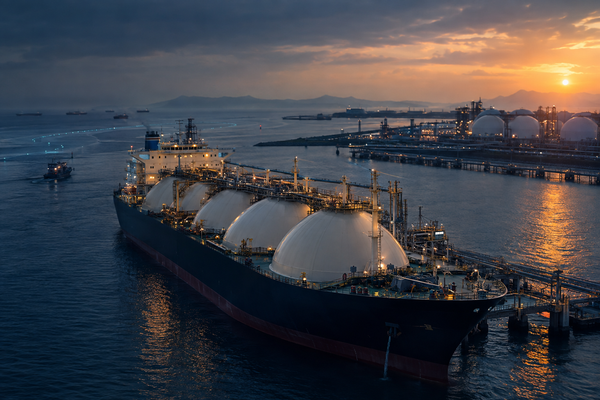
The Freight Paradox: Tanker Owners Are Ordering the Highest Newbuild Count Since 1973 at the Top of an All-Time Rate Cycle
VLCC daily earnings hit $128,000 last week, war-risk insurance through Hormuz has surged to 10 percent of hull value, and Clarksons's H1 tanker earnings averaged the strongest ever recorded. Owners have responded by ordering 150-plus VLCCs, the highest annual tally since 1973. This is a late-cy

The Clarksons H1 2026 Shipping Market Review, released on July 7, contains a number that deserves more attention than it received. Tanker earnings averaged $82,000 per day in the first half of 2026, the strongest environment on record for the sector. The ClarkSea Index, the broadest measure of global freight market health, rose 61 percent year-on-year to a $38,717 daily average. VLCC daily earnings were $128,000 on July 20 per Clarksons, Suezmax earnings at $148,000, Aframax at $109,000. War-risk insurance for a single Strait of Hormuz transit has surged from 0.25 percent of a ship's hull value in February to a range of 3 to 8 percent as of last week, according to industry data compiled by S&P Global. At $77.96 per metric ton, the current market cost of shipping crude from the Gulf to China is four times the five-year average of $18.91 per metric ton. Every single number in that catalog is at a historic high or a multi-year extreme. And yet tanker owners have ordered more than 150 VLCC newbuilds in 2026 through mid-year, the highest annual tally since 1973. That combination — record rates and record ordering — has almost never happened. The last time it did, in the early 1970s, it produced the deepest and longest tanker recession in industry history through 1974 to 1985. The market is currently pricing shipping stocks and freight forwards as if the rate cycle is durable. The yard order book is pricing something else.
The specific paradox deserves a slower reading. Historically, high rates draw newbuild orders on a two to three year lag, with deliveries arriving into softening markets. The 25 percent orderbook-to-fleet ratio being reported by Clarksons and cross-checked by Xclusiv Shipbrokers is the highest reading in decades. In dead-weight-ton terms, that represents roughly 240 million dwt of tankers on order against a fleet of about 960 million dwt. Standard newbuild delivery lead times are 30 to 36 months from order. That means the majority of these orders deliver into 2028 and 2029, at a rate that shipping economists have consistently found is incompatible with sustained day rates above breakeven. The Frontline breakeven analysis for the next twelve months, provided in the company's Q1 2026 investor materials, sets estimated average daily cash breakeven rates at $24,300 for VLCCs, $24,300 for Suezmaxes, and $23,600 for LR2/Aframaxes. Current time-charter-equivalent earnings are running four to six times breakeven. That gap is exactly what pulled 150-plus VLCC orders into being.
Fotios Katsoulas, director of tanker research at S&P Global Commodity Insights, has framed the security-premium piece explicitly for Platts.
"Heightened security risks in the Black Sea should increase owners' risk assessments and could support a higher freight premium," Katsoulas said. "This could come through higher freight requirements from owners, increased war-risk insurance costs, or a reduced pool of willing tonnage. Whether a meaningful and sustained freight premium develops will depend on the frequency of attacks and whether they begin to materially affect vessel availability or loading programs."
Katsoulas's framework is careful. Three transmission channels for a security premium: freight demands from owners, war-risk insurance, or reduced willing tonnage. Each is present in current data. Freight demands are visible in the Suezmax rate from Novorossiisk to Trieste, which delivered a July 20 time-charter-equivalent of $210,774 per day, versus the Global Suezmax Index at $158,111 per day the same day. That $52,663 differential is the specific security premium being extracted from Russia-Kazakhstan crude routes. War-risk insurance premiums have moved from historical 1 to 3 percent of hull value to 7.5 to 10 percent for Hormuz transits according to S&P Global-cited industry sources. Willing tonnage has visibly contracted, with Hormuz transits down 90 percent from pre-conflict levels as of July 20 per Clarksons, at approximately 12 crossings per day versus a pre-conflict baseline of 125.
The Katsoulas condition and the market's over-interpretation
The market is reading this as a permanent regime change. The Clarksons H1 review notes that tankers saw "disruption upside" from the Middle East conflict "amplifying already supportive fundamentals" of strong OPEC volumes, low fleet growth, consolidation, and sanctions. The four supportive fundamentals identified by Clarksons are not all permanent. OPEC volumes are policy-dependent and reversible on any coordination shift. Fleet growth is currently low but the orderbook has just guaranteed that fleet growth accelerates from 2028. Consolidation is a slow-moving structural factor. Sanctions can be relaxed. Only "sanctions plus conflict" — the specific combination powering current rates — is dependent on the geopolitical trajectory continuing. Katsoulas's third sentence is the one being under-priced: whether a sustained premium develops depends on the frequency of attacks and their material effect on availability. That is a specific, testable condition, not a structural assumption. Every element of the current freight-premium stack rests on that condition holding.
Svetlana Lobaciova, principal analyst at Gibson Shipbrokers, made a more targeted point in the same S&P Global piece.
"The risks are even more heightened now, but it is unclear whether there is scope for further increases in the premium for CPC loads," Lobaciova said.
Lobaciova's framing is the trader's question, not the analyst's. She is not asking whether the security situation deteriorates. She is asking whether the market has already priced the deterioration. The distinction matters. A CPC loading premium of $52,663 per day above the Global Suezmax Index is at the upper end of historical security-adjusted premiums. The premium has room to compress on any de-escalation, but limited additional room to expand on further deterioration because tonnage has already been withdrawn from the affected routes. That is a specific asymmetry: the premium is bounded to the upside and unbounded to the downside. Every tanker on order is a call option on that asymmetry going the wrong way.
Steve Gordon, Global Head of Clarksons Research, provided the July 20 snapshot that quantifies the current setup:
"Strait of Hormuz transits back to 90 percent below pre-conflict levels, with an average of 12 crossings per day over the past 5 days. VLCC earnings are $128,000 per day, up 32 percent versus start-June. Suezmax and Aframax earnings are up 63 percent and 68 percent over the same period to $148,000 per day and $109,000 per day."
Gordon's framing is descriptive rather than editorial, which is exactly why it matters. The 32, 63, and 68 percent moves in six weeks are not the earnings of a market in equilibrium. They are the earnings of a market being kept in disequilibrium by conflict, with tonnage effectively removed from the Hormuz artery and rerouted around the Cape of Good Hope for 30 to 50 percent longer voyages according to market participants cited by S&P Platts. The specific mathematical property of a market operating on rerouted voyages is that current earnings integrate over more voyage days per unit of cargo delivered. That inflates the daily rate but does not reflect a corresponding jump in trade demand. Trade demand has been roughly flat. What has moved is the effective supply-adjusted-for-distance, which is fundamentally reversible on any de-escalation.
The order book as the second-derivative tell
Lars Barstad, CEO of Frontline, one of the world's largest crude tanker owners, characterized the first quarter of 2026 in the company's Q1 investor materials.
"The first quarter of 2026 was marked by high volatility," Barstad said in the Q1 release.
Frontline's first-quarter TCE earnings were $103,500 per day on VLCCs, $72,400 per day on Suezmaxes, and $50,700 per day on LR2/Aframaxes. The Q2 book was 82 percent covered at $181,700 per day for VLCCs, 79 percent covered at $131,300 for Suezmaxes, and 68 percent covered at $125,000 for LR2/Aframaxes. Barstad's language of "high volatility" is significant precisely because Frontline is not ordering VLCCs at these levels. The 150-plus VLCCs on order in 2026 are being placed by owners further down the size and quality distribution, at yards in China and South Korea. The listed operators with the best cost bases, including Frontline, Hafnia, and other well-capitalized players, are choosing to run existing fleets rather than build. That is the second-derivative signal. The order book is being built by the shipowners with the least resilient balance sheets, banking on Middle East disruption remaining priced into rates through the delivery window.
The historical parallel is 1972 to 1975. Between 1972 and mid-1973, VLCC and ULCC orders reached a fleet ratio of roughly 30 percent, driven by the rate spike associated with the Yom Kippur War, the first oil embargo, and the closure of the Suez Canal. What followed was the longest tanker recession in the industry's recorded history, running through 1985. The 1973 order book assumed a bounded conflict would extend the demand-supply gap into the delivery window. It did not. The 2026 order book, at 25 percent of fleet against Israel-Iran plus Ukraine-Russia, is running the same logical trade.
Our view
The correct positioning has three legs. First, short the tanker equity complex on any ceasefire tape headline. FRO, INSW, and TNK trade at price-to-book multiples of 1.3 to 1.6, above their ten-year averages of 0.8 to 1.1, implying 15 to 30 percent downside on multiple compression alone. Second, long shipbuilders against short tanker equities on a two-year horizon. Yards have booked the current orderbook as contracted revenue; tanker owners have not booked their next four years of earnings. Third, and most direct, sell the 2028 VLCC TD3C forward strip against spot. FFAs trade around $54,000 per day versus a $24,300 estimated cash breakeven. Any ceasefire between now and delivery pulls the 2028 strip to $30,000 to $35,000 per day. The convexity favors the short.
The larger point is about what the freight market is saying about geopolitical risk pricing across asset classes. Equities are pricing a benign resolution. Credit is pricing muddle-through. Oil is pricing a specific price ceiling near $85 per barrel, up from $67 in early July. Tanker rates and the tanker orderbook are pricing something different: a bimodal outcome where either the current disruption extends through 2028 or it collapses within twelve months, with no intermediate scenario. The equities and credit assumptions are far too smooth for a bimodal risk distribution. The freight market has the risk profile approximately correct. Its response — ordering aggressively into a bimodal outcome — is exactly the wrong trade. That is the setup.
This note reflects the views of Solomon Grey Capital's Macro and cross-asset desk as of the date of publication and is provided for informational purposes only. It does not constitute investment advice, an offer, or a solicitation to buy or sell any security. Past performance is not indicative of future results.